
Good Touch / Bad Touch
The Danger Is Not Always A Stranger.
A lot of children who come through the family court system are victims of sexual abuse. And it’s not only adults hurting them.
You’d be surprised at just how many young children, some less than 5-years-old, have been sexually abused, not only by adults, but older children, including siblings, cousins, friends, and children of their parents’ friends.
Most parents teach their children to be wary of strangers, but what about the possibility of family and friends?
Child sexual abuse ranges from forcible touching, including groping, grabbing, squeezing or pinching the sexual or other intimate parts of a child, or having the victim do it to the perpetrator, to sodomy and rape.
Because many parents fail to educate their children about the possibility at all, it sometimes continues for months or years before the child finally outcries to someone.
No one really knows just how many cases go undetected.


Recognizing Grooming
It Often Starts Small.
With grooming, it starts innocently enough, through compliments, gifts, secrets, “games,” hugging, a kiss, or simple touching and escalates over time.
If taught early on to recognize and report such behavior to you when it first starts, you can keep your child safe and prevent more serious sexual abuse.
If left untreated, a child who is sexually abused suffers severe trauma and is likely to experience a lifetime of pain, including anxiety, depression, alcoholism, substance abuse, promiscuous sexual activity, low self-esteem and the inability to establish trusting relationships.
It’s not a stretch to argue that adults who were sexually abused as children, if left untreated, have higher instances of drug abuse and other self-destructive and criminal behavior.
When children dream about being a firefighter, astronaut, an animal scientist, or a hero, not one child says, “I want to be a heroin addict when I grow up.”
Unfortunately, it’s not uncommon for many child victims of sexual abuse to do the same thing to other children a few years later. It’s a terrible cycle.
Early Conversations Matter
Teach Body Parts and Private Zones.
We recommend teaching your child as early as possible the concept of good touch and bad touch.
If you need to use a doll or diagram to aid you, do so. Start putting them in a comfort zone by talking about things they like to do.
But avoid games. You don’t want your child to associate games with talk of what’s right and wrong.
Otherwise, it could not only be used to manipulate them, but if something bad ever does happen to your child and they are asked about it by the police or other professionals, it might become difficult to distinguish between truth or a lie and reality versus fantasy.
Once you feel your child is fully relaxed, introduce them to basic “anatomy,” such as the child’s mouth, chest, sexual parts, abdomen, lower back, thighs and buttocks.
No, you don’t need to teach a young child the names of specific genitalia. You can, for example, note the places your child pees or poops, or whatever you call it.
The focus is on how you and your child identify their intimate body parts and private zones.
Safe Boundaries
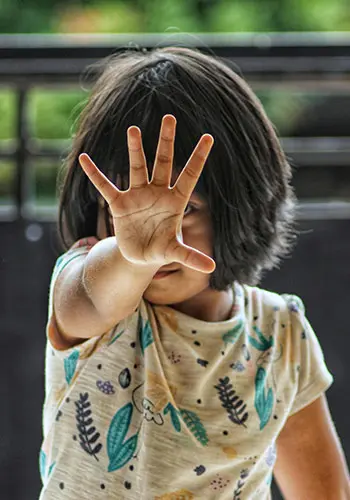
Teach Your Child To Speak Up.
After your child grasps basic “anatomy,” teach the difference between a good touch, like you hugging your child, and a bad touch, and which body parts and private zones are off-limits.
Reinforce that no one, whether a child or adult, should ever kiss your child without your permission, or touch them on their private parts or zones with a hand, private part, mouth or by other means.
Aside from a doctor with you present when medically necessary, these boundaries should never be crossed.
Your child should also know not to do the same to someone else, whether a child or adult, even if asked to.
Equally important, stress that if something happens to your child along the lines of what you discussed, s/he should report it to you immediately and that you will never blame or ridicule him or her for it.
A lot of outcries are delayed because the children involved are afraid their parents will be mad at them or they will get in trouble for doing something wrong.

Protecting Children Starts At Home
Be The Hero Your Child Needs.
Teaching these concepts can be uncomfortable for some parents. But it’s necessary.
These talks not only help prevent such all-too-common occurrences, but if your child is victimized, ensures that s/he receives help right away.
An added benefit is that it also increases the likelihood that a perpetrator will be identified quickly, resulting in consequences, supervision and treatment, saving countless other children from the horror of child sexual abuse.
Be the hero your child dreams of being.