
What Supervision Means
Learning From Experience.
The F.A.M.I.L.Y. Model of Parental Supervision by Carl A. Bartol, MPA, Esq., is essentially a modern parenting style that offers parents a simple, memorable, balanced and effective framework for supervising children and keeping them safe. Carl based this model upon a lifetime of relevant real-world experience as a juvenile prosecutor, investigator, teacher of parenting concepts and as a dedicated child advocate.
For 25 years, Associate County Attorney Carl A. Bartol served as a juvenile prosecutor with the Westchester County Attorney's Office Family Court Bureau Juvenile Delinquency Unit, where he was repeatedly rated a top performer. Although Carl handled cases in all Westchester County family courts, the majority of his time was spent prosecuting cases in Yonkers Family Court, located in the third largest city in New York State and the busiest of Westchester's three family courts. As the saying goes, Carl was "tried by fire" and perfected his skills working "in the trenches." For about five years he was left to work alone in Yonkers Family Court and handled all juvenile delinquency matters there, from petit larcenies to rapes and shootings. Since Yonkers borders the Bronx and the gang activity at that time didn't respect borders, Carl was extremely busy, but welcomed the experience gained. Yonkers Police have made significant headway since those early days. Eventually Carl was sent help, and trained and supervised other ACA's in the Yonkers branch, while handling the most serious cases. Years later, the Yonkers branch and White Plains and New Rochelle branches were consolidated under the supervision of a Deputy who works out of the White Plains office.
Early on as a juvenile prosecutor, with lessons learned from working in his younger days for three years as a direct care worker in a maximum-security facility for youth (New York State Division for Youth Harlem Valley Secure Center), and close to 10 years as a field investigator for New York State (Department of State Division of Licensing Services), an insurance company (Unum) and as a licensed private investigator (Qualifying Officer for Proudest, Inc. which became Talent Check, Inc.), Carl began to think of ways to teach parents how to properly supervise their children and keep them out of trouble.
A Career In Family Court.
As a Westchester County Family Court attorney Carl A. Bartol handled thousands of cases over the course of his career, the majority child-on-child, including several criminally negligent homicides (the only one in his Unit trusted with those matters during his tenure) and more rapes, robberies, gang-related shootings, stabbings and group assaults than you can count.
Contrary to public perception, most serious felony cases involving juveniles are prosecuted by the Westchester County Attorney's Office, not the Westchester District Attorney's Office.


Understanding Juvenile Cases.
Aside from original jurisdiction juvenile delinquency matters, over 90% of juvenile offender and adolescent offender cases involving teens charged with felonies that originate in the Westchester County Youth Part are eventually removed to Westchester County Family Court, where they are prosecuted as juvenile delinquents.
All non-violent felonies, including possession of a loaded firearm, and violent felonies, unless involving display of a firearm or deadly weapon, those that result in serious physical injuiry or certain sex offenses, are presumptively removable, absent a showing (by motion) of "extraordinary circumstances."
On top of that, many felonies involving the three noted exceptions, including gun and knife-point robberies, shootings, stabbings and the like, are frequently removed to Westchester County Family Court upon consent of the District Attorney's Office, in that it offers more rehabilitative services to youth. Because juvenile delinquency records are not open to the public, and the media seldom attends hearings in Westchester County Family Court, few cases make the news. Of those that do, the public erroneously assumes that they are being prosecuted in criminal court by the District Attorney's Office.
Experience That Held Up.
Carl A. Bartol successfully tried hundreds of juvenile delinquency matters over the course of his career, more than any other attorney in his former Unit, including the most serious sex offenses and highly contested cases. This often required him to lead police and Unit investigations. Consequently, given the complexity of many of these matters, they were the only ones in his Unit challenged at the appellate level.
At the Second Department Appellate Division (handled by the County Attorney's Office Appeals Bureau), except for a few cases of first impression, the findings of the lower family courts were consistently upheld. Carl was promoted twice, from Assistant County Attorney to Senior Assistant County Attorney and then to Associate County Attorney, on merit.
Prevention Work For Parents.
For about 10 years, Carl A. Bartol ran the Prevent Delinquency Project, where he and other volunteers met with parent groups in person and taught them what to look for to keep their children safe. Carl would literally show them gang beads and clothing, drug paraphernalia, common everyday items carried by kids and used as makeshift weapons, educate parents on street and online terminology, and provide warnings signs of when a child may be in trouble. It was during that time that Carl created the F.A.M.I.L.Y. Model parenting style. He also worked extensively on gang prevention concepts.
The PDF below is an example of gang education and prevention material Carl A. Bartol wrote and compiled with the aid of award winning children's picture book illustrator Steve Gray, called My Brother's "Friends," which he first distributed online in November 2008, and handed out at Prevent Delinquency Project events, to help parents start talking to young children about the dangers of joining a gang.
Carl explained to us that although Steve Gray, a former commercial illustrator for Fortune 500 companies turned children's book artist, was in such high demand that he ordinarily charged a lot more for his work, he was so concerned about the well-being of children, and appreciative of Carl's efforts to keep them safe, that he illustrated the entire e-book for what he would normally charge for one simple sketch.
You are welcome to download and use this copyrighted material with your children, provided it is not used for commercial purposes. While it may seem simplistic at first blush, as Carl explained while meeting with various parent groups, it is actually designed to facilitate hours of discussion with a young child about what family means, what friends are (and aren't), bad influences, how to recognize them, the impact of negative peers upon a child and his or her family, what to do when approached by the wrong children, who to turn to, etc.
Background & Publications
A Parenting Resource.
Carl A. Bartol has authored and published articles on tips for parents to keep their children safe and how to investigative the activities of troubled teens in a number of periodicals, including Our Children (April/May 2005), the magazine of the National Parent Teacher Association; PI Magazine (April 2007), the leading trade journal for private investigators; Westchester Family (September 2008); and is noted in Juvenile Justice, a Guide to Theory, Policy, and Practice, 7th Edition (December 2010), a respected college textbook. Carl has taught continuing legal education courses to other juvenile prosecutors for the County Attorneys’ Association of the State of New York on preparing child witnesses to testify at trial (in 2026 he received an award from CAASNY for his decades of public service), and at the Elizabeth Haub School of Law on New York's "Raise the Age" law in 2019. In 2024, Carl A. Bartol received the Extra Mile Award from the Westchester Children's Advocacy Center, for going above and beyond to support their mission. That's the place where caring highly trained clinicians forensically interview child victims of sexual abuse as part of juvenile and adult sex offense investigations.
Carl’s Prevent Delinquency Project was also referenced as a credible source in several FBI Law Enforcement Bulletins, including an April 1, 2012 article on diversion safes, at a time when they were not well known to law enforcement or parents.
View FBI Law Enforcement Bulletin Reference
Carl A. Bartol has spent decades as a child advocate. While he was zealously prosecuting juvenile delinquents for 25 years to hold them accountable for their actions, facilitate rehabilitative supervision and supportive services and ensure community safety, in his spare time, he was dedicated to finding ways to keep them out of the juvenile justice system to begin with.
When Carl shut down his Prevent Delinquency Project a few years ago, which he paid for out of his own pocket and never sought outside funding for, he inadvertently let the corresponding domain name, preventdelinquency.org, expire. It was then registered by someone else, for whatever purpose.
Carl wanted us to tell you that he has no association with the current domain name owner or website. It’s a shame, but the Internet can be like the Wild West at times.
We share Carl A. Bartol's view that his F.A.M.I.L.Y. Model of Parental Supervision, conceived in 2003, is still relevant and applicable today. The basics of parenting never change. Carl has granted parents and groups permission to share this copyrighted (TXU001117060) material freely, provided it is not used for profit and you kindly cite YourChildSafe.com as the source. We’re trying to reach as many parents as we can.
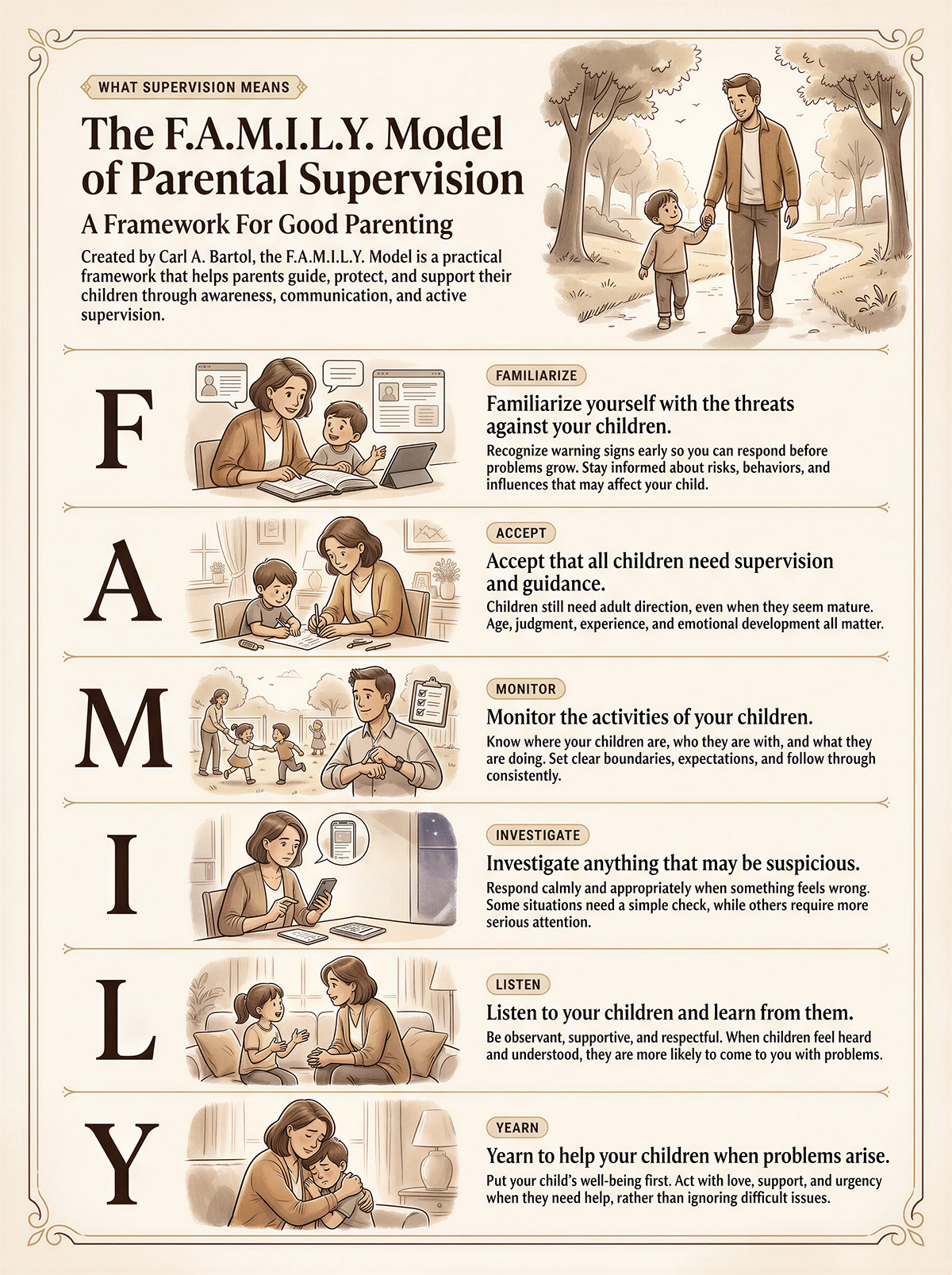
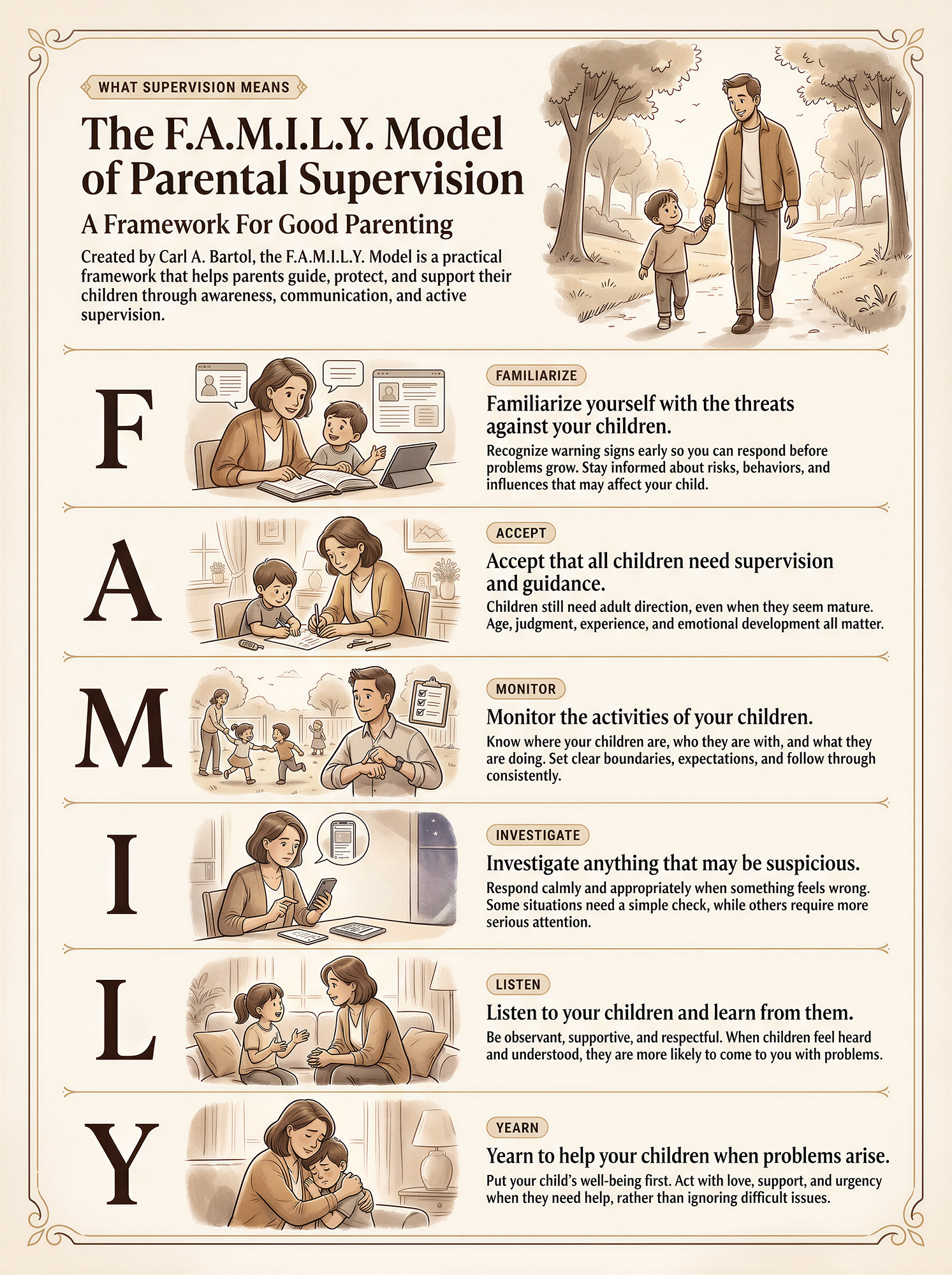
F.A.M.I.L.Y. Model of Parental Supervision
A Framework For Good Parenting.
Familiarize yourself with the threats against your children.
Ensuring the health and safety of your children requires early intervention when issues arise. If you are unable to recognize the "red flags" of a problem that exists, immediate corrective action is not possible. Do you know what it suggests if your teenager sucks on baby pacifiers, what drug is commonly transported in a water bottle, or which sportswear and designer clothing are used by gangs to identify their members?
Accept that all children need supervision and guidance.
By virtue of their age, children lack the knowledge, maturity of judgment, and experience of adults. Just because a child has a high grade-point average in school doesn’t mean s/he is capable of making major life decisions, or resisting the negative influence of peers. Don't mistakenly confuse physical with emotional development either. Your 12-year-old son or daughter may look 18, but s/he is still a child inside.
Monitor the activities of your children.
Parents have a responsibility to know where their children are at all times, who they are with and what they are up to. This requires setting guidelines for children to follow, including limits on their behavior and expectations. Sanctions and incentives are important in enforcing boundaries. Know all of your child's friends and work together with their parents. Verify what your children are up to.
Investigate anything that may be suspicious.
Adopt a balanced approach to parenting. The level of your intervention should correlate with the severity of the situation. Be careful not to become accusatory in tone, or you may destroy the bond that exists between you and your children. Trust is critical. Some matters require only a basic inquiry, like calling the parent of your child's friend to confirm their whereabouts. Other issues, such as suspected gang membership, substance abuse, reckless sexual practices, or running away from home, represent imminent threats to your child's well-being and warrant more invasive measures. Resist the temptation to confront your children with what you find. Instead, approach them with love and support.
Listen to your children and learn from them.
You know your children better than anyone else. Be observant and receptive to them. Learn to recognize what makes your children happy or sad, when things are going well, or when something is wrong. Listen, understand, and support them. Above all, treat your children with respect. Always be available for them and they will come to you with their problems.
Yearn to help your children when problems arise.
Put the interests of your children before your own. Don't be selfish. Remember, this isn't about you; it's about helping them. Disregard what your friends, colleagues, or neighbors might think. Feelings of embarrassment or humiliation waste precious time that you could be using to seek out appropriate treatment and services for your children. Ignoring the problem will only place them at greater risk.